

Trade schools and technical colleges now help prepare the next generation of ground source heat pump (GSHP) professionals. As demand rises, you need training partners who can teach ground loop skills alongside core heating and cooling fundamentals. Geothermal workforce development depends on these classrooms and labs to turn motivated students into job-ready technicians.
Programs across the country blend classroom instruction, hands-on lab work, and field experience built around industry standards. You'll see what these programs teach, where standout examples are taking shape, and how educators can expand their offerings. You'll also learn how the International Ground Source Heat Pump Association (IGSHPA) supports schools building a stronger talent pipeline.
Where Geothermal Workforce Development Programs Are Taking Root
Geothermal trade school programs across the country include installer workshops, operation and maintenance courses, and drilling-focused certificates. Schools in Pennsylvania, New York, New Mexico, and Massachusetts offer or are building programs with hands-on labs and field training. Several programs align with IGSHPA training objectives, which helps graduates move toward recognized industry credentials.
What Geothermal Trade School Programs Teach
Strong programs start with the fundamentals of heat transfer, refrigeration, and how ground loops exchange heat with the earth. From there, students learn loop sizing, pipe installation, pressure testing, and flushing procedures for residential and commercial systems. Many courses also cover commissioning and service, so graduates can support a system across its full life cycle.
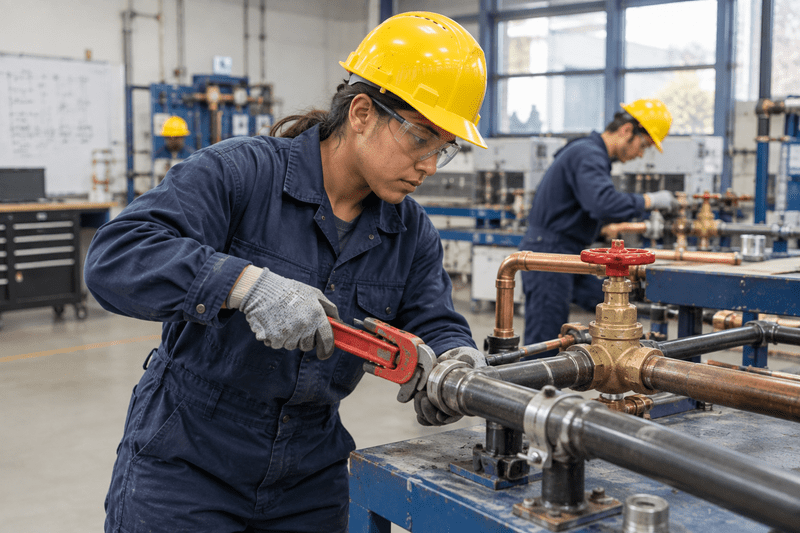
Hands-on lab time separates the strongest programs from options that rely on classroom lectures alone. For example, students who practice on a working GSHP system build confidence before they ever step onto a job site.
Drilling instruction adds another layer, since borehole work requires specialized equipment, safety training, and aquifer protection practices. However, few schools own a drilling rig, so partnerships with drillers and industry groups fill that gap. Programs that combine classroom, lab, and field learning give geothermal workforce development its strongest foundation.
The best programs also teach to the binational C448 standard, which guides system design and installation across North America. As a result, graduates speak the same technical language as the designers, inspectors, and contractors they'll work beside. In turn, your company can hire new technicians who need less retraining before joining a crew.
Geothermal Workforce Development Programs Making an Impact
Several schools across the country have built programs that give students real experience with ground source systems. Some focus on installer skills, while others center on system service or the drilling workforce. Here are a few examples worth knowing if you hire, train, or teach in the ground source industry.
- Lehigh Career & Technical Institute in Pennsylvania has taught IGSHPA-aligned installer workshops inside a lab with an operating geothermal system.
- Farmingdale State College in New York has hosted IGSHPA installer workshops through its Renewable Energy and Sustainability Center.
- Central New Mexico Community College added operation and maintenance courses after struggling to find a local installer for its systems.
- Framingham State University in Massachusetts plans a yearlong certificate in geothermal science and engineering that includes hands-on field training.
Massachusetts will host the first Geothermal Drilling Center of Excellence, a regional hub for drilling instruction. The Geothermal Drillers Association, Framingham Economic Development Corporation, and Home Energy Efficiency Team (HEET) lead the effort, which adds supervised hands-on practice with drilling equipment. A Climate Critical Workforce Training, Equipment, and Infrastructure grant from the Massachusetts Clean Energy Center will support the procurement of training-dedicated equipment later this year for future Massachusetts-based programming.
Each example shows how geothermal workforce development grows faster when schools, industry groups, and employers work together. Consequently, graduates leave these programs with skills that match what contractors and utilities need on real projects. Programs in other regions can adapt the same model to fit local markets and available resources.
How Educators Can Strengthen Geothermal Workforce Development
If you teach at a trade school or technical college, IGSHPA resources help you build or expand a GSHP program. Start by introducing students to the free Geo 101 online course, which covers core concepts at their own pace. Next, align your curriculum with IGSHPA's job-specific training modules so graduates can pursue recognized certificates.
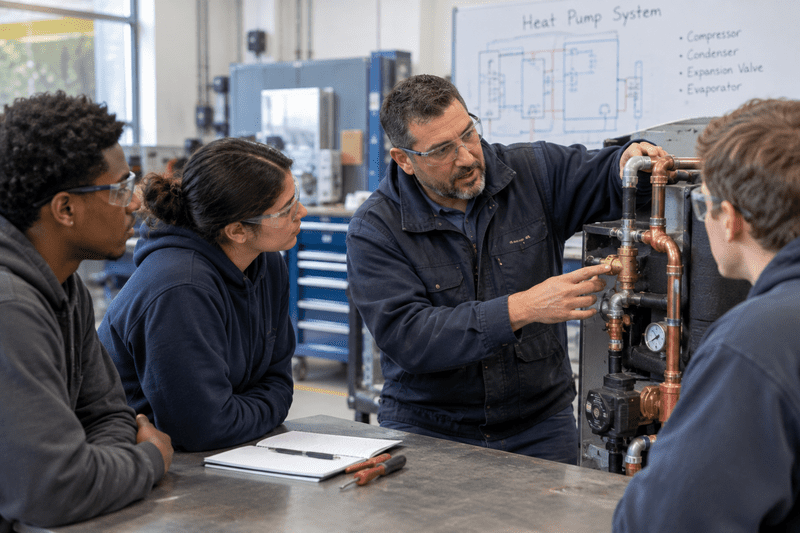
Industry partnerships matter just as much, since they connect students with equipment, mentors, and jobs after graduation. For instance, the Geothermal Market Capacity Coalition (GMCC) brings trade groups, drillers, installers, and educators together to grow the workforce. Similarly, IGSHPA's training and events calendar helps you find courses and webinars for your instructors.
Research also supports dedicated training centers as a way to close heat pump skills gaps at scale. According to Energy Research & Social Science, training and testing centers like those in Switzerland and Sweden can help.
Your program can play the same role locally and give geothermal workforce development a lasting home in your region. Meanwhile, the IGSHPA Annual Conference on September 20 to 22, 2027, connects educators with employers and industry experts. Plus, an IGSHPA membership keeps your school connected to new standards, research, and training opportunities.
Bring Standards-Based Training to Your Region
Trade school programs give the ground source industry a steady supply of skilled, job-ready technicians. Whether you teach, hire, or train, your involvement strengthens geothermal workforce development in your community. Every program that aligns with industry standards brings more certified professionals into the field each year.
Explore IGSHPA's training resources to see how they can support your students, instructors, and new hires. Then, consider connecting with peers at upcoming webinars and the 2027 IGSHPA Annual Conference. Contact the IGSHPA team to explore how your school or company can bring standards-based training to your region.