A Look at Geothermal Apprenticeship Programs in the Current Pipeline

​Apprenticeships give ground source heat pump (GSHP) companies a proven way to train new workers while they earn. You get skilled help on the job site, and apprentices get a clear path into a growing trade. Geothermal workforce development now includes several apprenticeship and pre-apprenticeship programs worth knowing about.

The International Ground Source Heat Pump Association (IGSHPA) supports these efforts with training that complements hands-on learning in the field. You'll see how apprenticeships fit the ground source workforce and which programs are moving through the pipeline now. You'll also learn practical ways your company can host apprentices and build a stronger crew over time.

Where Geothermal Workforce Development Apprenticeships Stand Today

Geothermal apprenticeship programs in the current pipeline include drilling pre-apprenticeships, union driller apprenticeships, and regional training hubs. Most programs blend classroom instruction with supervised field work, and several connect graduates directly with hiring employers. Pairing an apprenticeship with IGSHPA training helps new workers build recognized skills faster.

How Apprenticeships Fit the Ground Source Workforce

An apprenticeship combines paid, on-the-job learning with structured instruction under the guidance of experienced professionals. Registered apprenticeships follow approved standards, so apprentices earn credentials that employers across the trade recognize. Pre-apprenticeships come first and give newcomers the basic skills and safety training they need to qualify.
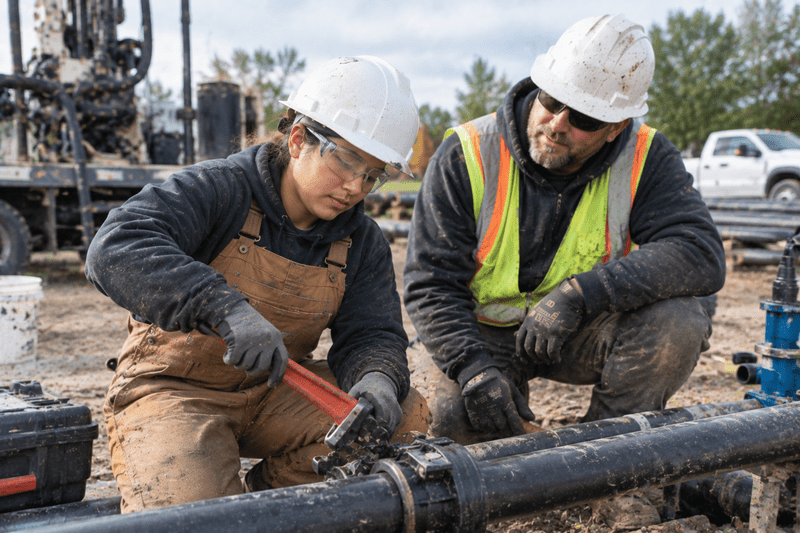
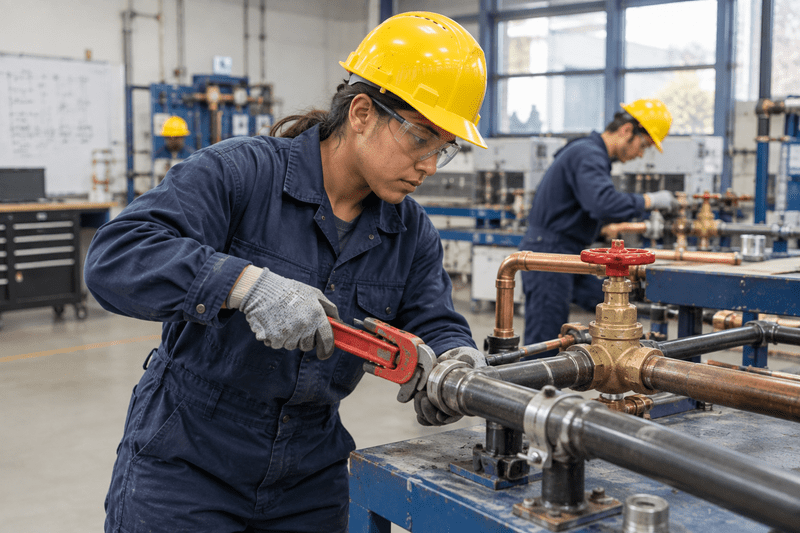
Apprentice practicing pipe work under supervision on a job site

Ground source work suits the apprenticeship model well, since crews master drilling and loop installation best through field experience. For example, an apprentice driller can practice grouting and pressure testing under supervision before working independently.

However, drilling training takes time, and small companies often struggle to spare rigs and mentors for new hires. As a result, shared training hubs and partnerships help spread that effort across many employers. Apprenticeships built this way give geothermal workforce development a steady pipeline of field-ready talent.

Heating, ventilation, and air conditioning (HVAC) apprenticeships also create a strong starting point for future GSHP installers. Meanwhile, some union training centers are adding heat pump equipment so apprentices can practice on modern systems. Adding ground source training to those programs helps apprentices move into GSHP work with confidence.

Geothermal Workforce Development Apprenticeships Worth Watching

Several programs now offer structured routes into ground source careers, with a strong focus on drilling. Some are fully registered apprenticeships, while others serve as pre-apprenticeships that prepare candidates for paid positions. Here are a few to watch if you hire, mentor, or train ground source workers.

  • The Geothermal Drillers Association offers a two-week pre-apprentice Geothermal Drilling Field Technician Intensive that blends classroom time with hands-on drilling labs.
  • Graduates of the intensive join a database of trained candidates and may move into paid apprenticeships in the industry. These are currently scheduled in Kentucky, Massachusetts, and New York.
  • International Union of Operating Engineers Local 150 runs a geothermal and water well driller apprenticeship covering drilling methods and safety.
  • A planned drilling center of excellence in Massachusetts will add a training rig so students can drill under supervision.

Regional teams in a Department of Energy workforce prize are also launching training tied to employer hiring commitments. Their final-phase programs will report new hires and workers trained, offering useful models for employers nationwide.

Each program adds capacity to geothermal workforce development by giving new workers supervised, real-world experience. Consequently, employers gain access to candidates who already understand job site safety and drilling basics. You can also post openings on IGSHPA's job board to reach candidates finishing these programs.

How Employers Can Strengthen the Geothermal Workforce Development Pipeline

Your company plays a central role in any apprenticeship, since apprentices learn most of their skills on your crews. Start by pairing each apprentice with a patient mentor who models safe, standards-based work every day. Then, give apprentices a clear plan that moves them from observation to supervised tasks and independent work.
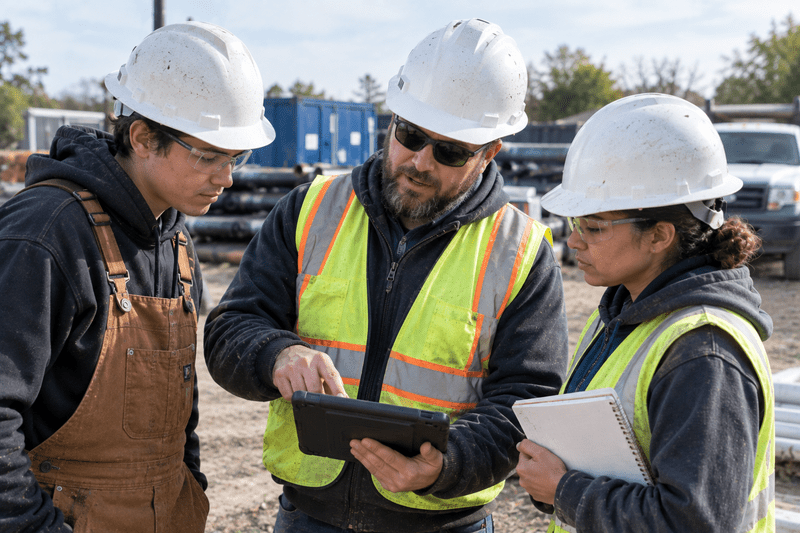
Supervisor guiding an apprentice through a clear training plan for geothermal workforce development

IGSHPA training fits neatly alongside field learning, so apprentices can build knowledge between shifts. For instance, new hires can start with the free Geo 101 online course before tackling job-specific modules. Drillers can then pursue the Ground Heat Exchanger Installer (GHXI) course to earn a recognized certificate.

Coordination matters just as much, because skills systems break down when employers, schools, and programs work in isolation. According to Energy Research & Social Science, skills systems for energy transitions face persistent gaps in responsiveness, equity, and coordination.

Groups like the Geothermal Market Capacity Coalition (GMCC) help close that gap by connecting drillers, installers, educators, and trade groups. Every apprentice you train strengthens geothermal workforce development and builds loyalty within your own crew. Similarly, the IGSHPA Annual Conference on September 20 to 22, 2027, connects you with program leaders and future hires.

Build Your Crew Through Apprenticeships

Apprenticeships turn motivated newcomers into skilled drillers and installers who understand ground source work from the start. Programs in the current pipeline show how geothermal workforce development can grow through partnerships and hands-on learning. Your company can join that effort by hosting apprentices and backing their growth with IGSHPA training.

Start by connecting with drilling associations, union training centers, or local schools that run apprenticeship programs. Next, map out which IGSHPA courses each apprentice should complete as they progress through your program. Get in touch with IGSHPA to find training that supports every apprentice on your crew.

Published
Categorized as Blogs

Geothermal Workforce Federal Grants Are Meant to Support

​Federal workforce grants can help train the drillers, installers, and technicians that ground source heat pump (GSHP) projects demand. Knowing who these programs target helps you decide where your team fits and which opportunities deserve your attention. Geothermal workforce development funding now flows through prize competitions, state-run training grants, and regional partnerships.

The International Ground Source Heat Pump Association (IGSHPA) keeps members informed on federal developments that shape industry growth. You'll learn which federal programs support the GSHP workforce and which roles they're designed to help. You'll also see how certified credentials position your team to take part in funded training and hiring efforts.

What Geothermal Workforce Development Grants Support

Federal geothermal workforce grants support drillers, installers, service technicians, and trainers who build and maintain ground source systems. Current programs include a Department of Energy prize for regional partnerships and state-run contractor training grants. Together, these programs fund the training, certification, and hiring pathways that grow a qualified ground source workforce.

Which Federal Programs Fund Geothermal Workforce Development

The U.S. Department of Energy (DOE) runs a prize competition built specifically for the geothermal heat pump workforce. Called the Partnerships to Accelerate Training and Hiring for Geothermal Heat Pumps (GHP PATHs) Prize, it rewards regional partnerships. Each team focuses on geothermal heat exchange systems and shallow drilling, two areas where skilled workers remain scarce.

According to the DOE, eight teams advanced in September 2026 to the prize's final phase. In that phase, teams will put their programs to work and report new hires and workers trained. The winning teams represent New England, Alaska, Colorado, the Midwest, and the Northwest, which shows how widely the need extends.

Meanwhile, the Training for Residential Energy Contractors (TREC) program gives states federal funds to train, test, and certify contractors. States such as Colorado, Maine, and Minnesota now run TREC programs focused on residential efficiency and electrification work.

However, TREC eligibility varies by state, so you should confirm whether your state's program covers ground source training. IGSHPA's federal outlook update also helps you follow policy changes that affect the GSHP industry. Tracking both programs gives you a clearer picture of where geothermal workforce development support is headed.

The Workers These Grants Are Meant to Support

Federal workforce programs aim to expand the pool of people who design, drill, install, and maintain ground source systems. Each program defines eligibility differently, yet several roles appear again and again across funded efforts. Here are the groups most likely to benefit when federal support reaches the ground source industry.

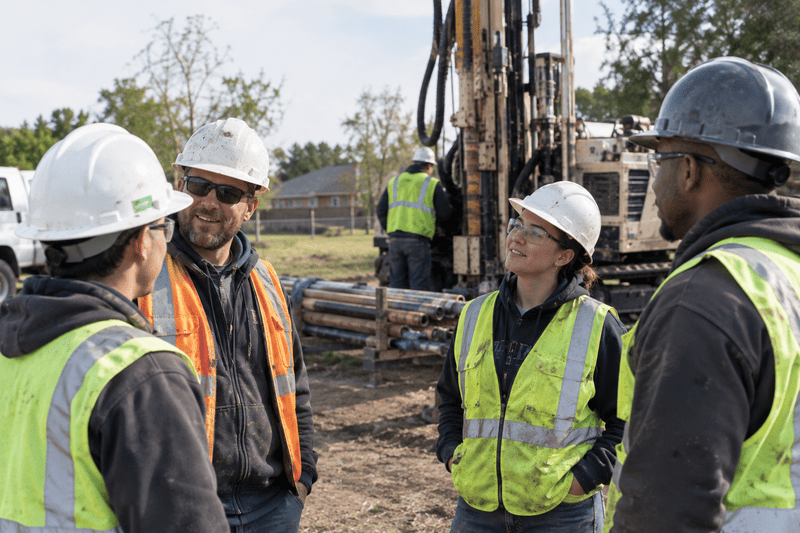
Drilling crew talking at a job site, representing the workers federal workforce grants aim to support
  • Shallow drillers who bore and grout vertical loops receive special attention because the DOE prize targets drilling skills directly.
  • Heating, ventilation, and air conditioning (HVAC) technicians can upskill into GSHP installation and service through funded training programs.
  • New entrants, including students and career changers, gain structured pathways into the trade with support from employers.
  • Trainers and training providers can expand their programs, add equipment, and reach more workers across their regions.

For employers, the GHP PATHs model also ties training to real jobs through hiring commitments from local companies. As a result, trainees move from the classroom into paid work instead of searching for opportunities on their own. Linking funding to hiring makes geothermal workforce development more durable for both workers and the companies that employ them.

Research supports this approach, since grants alone rarely close a skills gap without strong training infrastructure. According to Energy Research & Social Science, training grants should pair with national training centers backed by qualifications and accreditations.

Position Your Team for Geothermal Workforce Development Funding

Funded programs look for trainers and contractors who can prove their work meets recognized industry standards. IGSHPA's job-specific training and certificates give your team credentials that incentive and workforce programs can verify. In fact, states and provinces are adopting IGSHPA training as a quality benchmark for their programs.

Contractors shaking hands over job site plans while partnering on geothermal workforce development

Partnerships matter too, because federal workforce programs often reward collaboration between employers, trainers, and community groups. For example, the Geothermal Market Capacity Coalition (GMCC) connects drillers, installers, educators, and trade groups working on the same goals.

You can also list your certified staff in the IGSHPA business directory so partners and program administrators can find you. Similarly, the IGSHPA Annual Conference on September 20 to 22, 2027, helps you meet potential partners in one place. Each connection you build strengthens your role in geothermal workforce development and your readiness for future funding rounds.

Policy priorities can shift from year to year, so staying informed keeps your team ready to act quickly. Consequently, companies with certified staff and strong partnerships can respond faster when new opportunities open. Your investment in credentials today keeps your company ready whenever a funded project needs qualified workers.

Prepare Your Workforce for What Comes Next

Federal grants aim to build a larger, better-trained workforce for every stage of a ground source project. Drillers, installers, technicians, and trainers all stand to gain when funding meets strong standards and partnerships. IGSHPA certification helps your company play a lasting part in geothermal workforce development, no matter how programs evolve.

Start by reviewing which IGSHPA credentials match the roles your team fills today. Next, check your state's workforce and incentive programs to see where certified professionals can take part. Reach out to IGSHPA to learn how certification can prepare your team for funded training and hiring opportunities.

Published
Categorized as Blogs

A Look at Geothermal Trade School Programs Across the Country

​Trade schools and technical colleges now help prepare the next generation of ground source heat pump (GSHP) professionals. As demand rises, you need training partners who can teach ground loop skills alongside core heating and cooling fundamentals. Geothermal workforce development depends on these classrooms and labs to turn motivated students into job-ready technicians.

Programs across the country blend classroom instruction, hands-on lab work, and field experience built around industry standards. You'll see what these programs teach, where standout examples are taking shape, and how educators can expand their offerings. You'll also learn how the International Ground Source Heat Pump Association (IGSHPA) supports schools building a stronger talent pipeline.

Where Geothermal Workforce Development Programs Are Taking Root

Geothermal trade school programs across the country include installer workshops, operation and maintenance courses, and drilling-focused certificates. Schools in Pennsylvania, New York, New Mexico, and Massachusetts offer or are building programs with hands-on labs and field training. Several programs align with IGSHPA training objectives, which helps graduates move toward recognized industry credentials.

What Geothermal Trade School Programs Teach

Strong programs start with the fundamentals of heat transfer, refrigeration, and how ground loops exchange heat with the earth. From there, students learn loop sizing, pipe installation, pressure testing, and flushing procedures for residential and commercial systems. Many courses also cover commissioning and service, so graduates can support a system across its full life cycle.

Trade school student tightening pipe fittings during hands-on training in a lab

Hands-on lab time separates the strongest programs from options that rely on classroom lectures alone. For example, students who practice on a working GSHP system build confidence before they ever step onto a job site.

Drilling instruction adds another layer, since borehole work requires specialized equipment, safety training, and aquifer protection practices. However, few schools own a drilling rig, so partnerships with drillers and industry groups fill that gap. Programs that combine classroom, lab, and field learning give geothermal workforce development its strongest foundation.

The best programs also teach to the binational C448 standard, which guides system design and installation across North America. As a result, graduates speak the same technical language as the designers, inspectors, and contractors they'll work beside. In turn, your company can hire new technicians who need less retraining before joining a crew.

Geothermal Workforce Development Programs Making an Impact

Several schools across the country have built programs that give students real experience with ground source systems. Some focus on installer skills, while others center on system service or the drilling workforce. Here are a few examples worth knowing if you hire, train, or teach in the ground source industry.

  • Lehigh Career & Technical Institute in Pennsylvania has taught IGSHPA-aligned installer workshops inside a lab with an operating geothermal system.
  • Farmingdale State College in New York has hosted IGSHPA installer workshops through its Renewable Energy and Sustainability Center.
  • Central New Mexico Community College added operation and maintenance courses after struggling to find a local installer for its systems.
  • Framingham State University in Massachusetts plans a yearlong certificate in geothermal science and engineering that includes hands-on field training.

Massachusetts will host the first Geothermal Drilling Center of Excellence, a regional hub for drilling instruction. The Geothermal Drillers Association, Framingham Economic Development Corporation, and Home Energy Efficiency Team (HEET) lead the effort, which adds supervised hands-on practice with drilling equipment. A Climate Critical Workforce Training, Equipment, and Infrastructure grant from the Massachusetts Clean Energy Center will support the procurement of training-dedicated equipment later this year for future Massachusetts-based programming.

Each example shows how geothermal workforce development grows faster when schools, industry groups, and employers work together. Consequently, graduates leave these programs with skills that match what contractors and utilities need on real projects. Programs in other regions can adapt the same model to fit local markets and available resources.

How Educators Can Strengthen Geothermal Workforce Development

If you teach at a trade school or technical college, IGSHPA resources help you build or expand a GSHP program. Start by introducing students to the free Geo 101 online course, which covers core concepts at their own pace. Next, align your curriculum with IGSHPA's job-specific training modules so graduates can pursue recognized certificates.

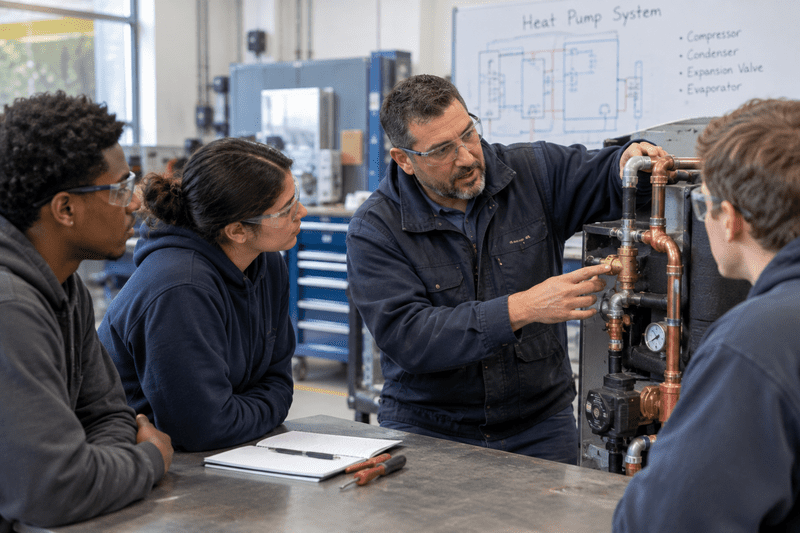
Instructor explaining heat pump components to students as part of geothermal workforce development training

Industry partnerships matter just as much, since they connect students with equipment, mentors, and jobs after graduation. For instance, the Geothermal Market Capacity Coalition (GMCC) brings trade groups, drillers, installers, and educators together to grow the workforce. Similarly, IGSHPA's training and events calendar helps you find courses and webinars for your instructors.

Research also supports dedicated training centers as a way to close heat pump skills gaps at scale. According to Energy Research & Social Science, training and testing centers like those in Switzerland and Sweden can help.

Your program can play the same role locally and give geothermal workforce development a lasting home in your region. Meanwhile, the IGSHPA Annual Conference on September 20 to 22, 2027, connects educators with employers and industry experts. Plus, an IGSHPA membership keeps your school connected to new standards, research, and training opportunities.

Bring Standards-Based Training to Your Region

Trade school programs give the ground source industry a steady supply of skilled, job-ready technicians. Whether you teach, hire, or train, your involvement strengthens geothermal workforce development in your community. Every program that aligns with industry standards brings more certified professionals into the field each year.

Explore IGSHPA's training resources to see how they can support your students, instructors, and new hires. Then, consider connecting with peers at upcoming webinars and the 2027 IGSHPA Annual Conference. Contact the IGSHPA team to explore how your school or company can bring standards-based training to your region.

Published
Categorized as Blogs

How to Become a Certified Geothermal Installer

​Ground source heat pump (GSHP) projects need skilled installers, and certified professionals are in high demand across the industry. Whether you work in heating and cooling, drilling, or excavation, certification shows owners you can install systems the right way. Geothermal workforce development gives you a clear, structured path from your first course to a recognized credential.

The International Ground Source Heat Pump Association (IGSHPA) offers job-specific training and certificates for every role on a GSHP project. You'll learn which steps to take first, which credential fits your job, and how to keep it active. You'll also see how certification helps your company win trust from owners, utilities, and incentive programs.

How Geothermal Workforce Development Leads to Installer Certification

To become a certified geothermal installer, start with foundational training and review the C448 design and installation standard. Next, complete the IGSHPA course that matches your role, such as residential installation or ground heat exchanger installation. Finally, pass the course exam to earn your certificate, then renew it every three years with continuing education.

Build Your Foundation Before You Choose a Course

Strong installers start with a solid grasp of how ground loops and heat pumps work together. If you're new to the field, IGSHPA's free Geo 101 online course gives you that groundwork at your own pace. Experienced heating and cooling technicians can use it as a refresher before moving into advanced modules.

Installer reviewing ground loop plans before starting field work

Next, get familiar with the binational C448 standard, since every new IGSHPA course builds on its requirements. IGSHPA recommends reviewing the standard before training, and members can get a licensed copy directly through IGSHPA.

You should also check the licensing rules in your state or province before you start any field work. Requirements differ by location, so IGSHPA keeps a licensing and continuing education requirements resource to help you plan ahead. Handling these basics early helps you move through geothermal workforce development programs without delays or surprises.

As a result, you'll walk into your first course with the context you need to absorb technical material. In addition, you'll get more value from hands-on lessons when the core concepts already feel familiar. Consequently, your path to certification feels more manageable for both you and your employer.

Choose the Right Geothermal Workforce Development Path for Your Role

IGSHPA's new curriculum breaks installer training into modules, so you can train for the exact work you perform. The courses replace the older Accredited Installer program, which covered every job function in a single course. Each path below ends with an optional exam that earns you a recognized credential.

  • Installation technicians can take the GSHP Residential Installation Technician (GRIT) course to master residential heat pump installation.
  • Drillers and excavators can complete the Residential/Light Commercial Ground Heat Exchanger Installer (GHXI) course to earn their certificate.
  • Service technicians can pursue the GSHP Residential Service Technician (GRST) certificate to diagnose and maintain installed systems.
  • Contractors who design and oversee residential jobs can earn the GSHP Residential System Designer (GRSD) certification through CSA Group.

IGSHPA expects many states and provinces to require GRSD certification in place of the legacy Accredited Installer credential. Meanwhile, IGSHPA recommends that other team members take the installer, service, and ground heat exchanger courses based on their duties. Matching each person to a module turns geothermal workforce development into a practical plan for your whole company.

Also, remember that certification exams are optional, so some professionals take courses purely to build knowledge. However, passing the exam gives you a credential that owners, utilities, and incentive programs can verify.

How Renewal Supports Long-Term Geothermal Workforce Development

Earning your certificate is a major milestone, but keeping it active matters just as much for your career. You must renew IGSHPA certificates every three years and submit continuing education units (CEUs) each time. Before renewing, you'll complete IGSHPA's online CEU form to document the learning you've done since your last cycle.

Crew members discussing job-specific installation skills together

Renewal also keeps your skills aligned with new piping materials, heat transfer fluids, and updated industry standards. For example, IGSHPA's monthly Dig Deeper webinars give you a convenient way to learn from experienced industry voices. Similarly, the IGSHPA Annual Conference, scheduled for September 20 to 22, 2027, connects you with peers and trainers.

Research supports the value of credentials backed by clear standards and ongoing skills assessment. According to Energy Research & Social Science, closing the skills gap requires training backed by qualifications, standards, and accreditations.

Your renewed credential shows owners and utilities that your skills reflect current practices, not outdated methods. Every renewal cycle also reinforces geothermal workforce development by keeping qualified professionals active in the field. In turn, your company builds a reputation for quality that helps you stand out on competitive bids.

Start Your Certification Path With IGSHPA

Becoming a certified geothermal installer takes planning, but IGSHPA gives you the tools you need along the way. Start with the fundamentals, choose the course that fits your role, and keep your credential active through renewal. Each step you take strengthens your career and supports geothermal workforce development across the ground source industry.

Browse the IGSHPA training calendar to find upcoming virtual and in-person courses that match your schedule. Also, consider an IGSHPA membership to connect with experts and stay current on training opportunities. Contact IGSHPA today to map out the certification path that fits your crew and your goals.

Published
Categorized as Blogs

Understanding the GSHP Installer Shortage and What’s Being Done About It

Demand for ground source heat pump (GSHP) systems keeps climbing, yet the pool of qualified installers has not kept pace. You see the gap every time a project stalls because no local crew can design, drill, or commission the loop. Geothermal workforce development now sits near the top of the industry's priority list, and real solutions are taking shape.

The International Ground Source Heat Pump Association (IGSHPA) has spent decades training the professionals who make every installation succeed. You'll find out what's driving the installer shortage and why the gap matters for your projects and your business. You'll also see how training, certification, and industry partnerships are building a stronger pipeline of skilled workers.

How Geothermal Workforce Development Is Closing the GSHP Installer Gap

The GSHP installer shortage stems from rising demand and the specialized design, drilling, and loop skills few workers have yet. To close the gap, IGSHPA and its partners offer job-specific training and certifications built on the binational C448 standard. States, provinces, and utilities are also adopting these credentials as benchmarks, which helps a qualified workforce grow faster.

Why the GSHP Installer Shortage Keeps Growing

You feel the pressure when GSHP projects compete for the same small pool of qualified designers and crews. Utilities, school districts, and developers are pursuing more ground loop projects, including shared thermal energy networks (TENs). Meanwhile, federal and state decarbonization programs are adding demand, and the certified workforce has struggled to keep pace.

Crew backfilling a residential trench during ground loop installation

Ground loop work also demands skills that traditional heating, ventilation, and air conditioning (HVAC) training rarely covers. For example, your crews need to understand borehole drilling, grouting, pipe fusion, pressure testing, and flushing requirements. Similarly, drillers who come from water well or geotechnical work must adapt their methods to closed loop installations.

Research confirms the problem extends beyond North America and affects every role on a ground source project. According to Energy Research & Social Science, too few trained designers, installers, and drillers are slowing deployment in Britain.

The shortage affects you directly, because every unqualified installation risks poor performance and damages confidence in the technology. Owners and utilities also hesitate to commit when they cannot find certified professionals near their projects. As a result, geothermal workforce development has shifted from a long-term goal into an immediate business need.

How Training Strengthens Geothermal Workforce Development

Training gives your team a clear, standards-based path into ground source work without guesswork on the job site. IGSHPA partners with CSA Group on accredited courses built around the 2025 edition of the C448 design and installation standard. Instead of one broad course, the curriculum breaks into job-specific modules so you can train each person for their role.

Professionals reviewing plans together to advance geothermal workforce development
  • The GSHP Residential Installation Technician (GRIT) certificate prepares your crews to install residential systems to current standards.
  • Drillers and excavators can earn the Ground Heat Exchanger Installer (GHXI) certificate for residential and light commercial loops.
  • Service technicians can pursue the GSHP Residential Service Technician (GRST) certificate to troubleshoot and maintain systems with confidence.
  • Inspectors and project managers can complete the fully online GSHP System Verification and Inspection (GSVI) course at their own pace.
  • Designers can work toward the GSHP Commercial System Designer (GCSD) or GSHP Residential System Designer (GRSD) certification.

Plus, the free Geo 101 online course gives new hires and trade school students an easy starting point. Educators can also use these modules to align classroom programs with geothermal workforce development goals in their region.

Each credential signals to owners, utilities, and incentive programs that your team follows accepted industry practices. Furthermore, IGSHPA members gain access to training resources that help you certify more people across your company.

Industry Partnerships Driving Geothermal Workforce Development

Training alone cannot close the gap, so IGSHPA works with governments, utilities, and allied organizations to scale results. States and Canadian provinces are increasingly adopting IGSHPA training as a quality benchmark for their incentive programs. When your team holds these credentials, you're better positioned for projects tied to those programs.

IGSHPA also belongs to the Geothermal Market Capacity Coalition (GMCC), which unites trade groups, drillers, installers, manufacturers, and educators. The coalition supports training centers that help drillers and installers build the skills that growing markets demand.

Beyond formal courses, IGSHPA's Town Hall and monthly Dig Deeper webinars keep working professionals current on new practices. Likewise, the IGSHPA Annual Conference on September 20 to 22, 2027, connects you with trainers, peers, and industry leaders. Together, these efforts give your company more ways to recruit, train, and retain skilled people over time.

Your participation matters, because industry-wide progress depends on companies that invest in their people. Every certified employee you add strengthens geothermal workforce development in your local market and across the industry. Consequently, your company earns a stronger reputation with owners, utilities, and the design teams that specify ground source systems.

Build Your Team's Future With IGSHPA Training

The GSHP installer shortage is real, but you have proven tools to build a qualified team. IGSHPA training, certification, and membership give your company a direct role in geothermal workforce development. Each credential your employees earn positions your company for new projects, programs, and partnerships across the ground source industry.

Start by exploring the training and certification programs that match each role on your team. Next, consider a business membership so your company appears in the IGSHPA directory and stays connected to industry updates. Reach out to the IGSHPA team today to find the right training path for your crews.

Published
Categorized as Blogs

Inside the Ambient Loop Geothermal Heat Pump System: Community-Scale Thermal Energy Networks Next Step

​Community-scale ground source heat exchange is moving quickly from concept into funded infrastructure. Utilities, campuses, and municipalities are all studying shared loop projects. At the center of that shift sits the ambient loop geothermal heat pump system, a shared ground heat exchanger (GHX) that ties multiple buildings to a common ground heat exchanger.

The loop runs near ground temperature instead of a hot or chilled setpoint. Each building then uses its own water-source heat pumps to produce the temperature it actually needs. That one design decision changes nearly everything downstream, from pipe sizing to who holds responsibility for the ground heat exchanger.

What Sets an Ambient Loop Geothermal System Apart

Conventional district energy distributes a finished product. Steam, hot water, or chilled water leaves a central plant at a controlled temperature. An ambient loop does the opposite. It distributes a temperature range and lets each building finish the job on site.

ambient loop geothermal system

That structural difference produces a few practical consequences:

  • Loop temperatures float across a wide band, often somewhere between 40°F and 90°F depending on the engineer's design parameters, season and load profile.
  • Distribution losses drop sharply, since the fluid sits close to the surrounding earth temperature.
  • Heat rejected by one building becomes usable heat for another building on the same loop.
  • A single ground heat exchanger serves the whole cluster rather than one property line.

Anyone reviewing this territory should start with how district systems and thermal energy networks are defined and scoped. The heat transfer principles remain the same as any single-building install, and the mechanics of a geothermal heat pump still govern capacity at the equipment level. What changes is the boundary of the design problem.

Load Diversity Is the Quiet Engine of the Network

Mixed-use blocks rarely need the same thing at the same hour. A grocery store rejects heat almost continuously. Apartments upstairs need heating on the same winter morning. An office next door swings between both within a single day.

An ambient loop turns that mismatch into an asset. Heat moves building to building through the loop before it ever reaches the ground. The ground heat exchanger then handles only the net imbalance. Ground heat exchanger length can shrink well below the sum of every building's individual peak.

Capturing that benefit requires better modeling, not just bigger spreadsheets. Peak block loads will not reveal diversity. Hourly simulation across a full year will. Designers also need honest occupancy schedules, because assumed profiles tend to overstate simultaneity. Reviewing documented project examples helps calibrate expectations before a ground heat exchanger goes out to bid.

Design Details That Decide Ambient Loop Geothermal System Performance

Shared loops fail slowly, not suddenly. Poor decisions show up as fluid temperature drift over five or ten years. A few details deserve early attention:

  • Annual thermal balance. Track heat added and removed across twelve months, not just design day extremes.
  • Pumping strategy. Distributed pumping at each building often beats one central pump for part-load efficiency.
  • Hydraulic separation. Building interfaces need clear control logic so one operator cannot starve a neighbor.
  • Testing and verification. Formation thermal conductivity testing carries more weight when many buildings depend on a common ground heat exchanger.
  • Expansion capacity. Networks grow, so leave headroom in mains and vault space for future connections.
ambient loop geothermal system

Documentation matters just as much as calculation. Loop construction, fusion, purging, and flushing all need to follow the standards and specifications the industry already relies on. Crews working on a network loop are building shared infrastructure. A single poor fusion joint now affects several owners rather than one homeowner.

Ownership, Metering, and Operating Responsibility

Technical design is only half of a network project. The other half is governance. Someone must own the loop, maintain it, and answer for its performance in year fifteen.

Models vary widely. Regulated utilities own the loop in some states. Third parties own it in others. Building owners occasionally retain their own connections and share only the distribution main. Each arrangement reshapes contracts, commissioning scope, and warranty language. The question of who owns the ground heat exchanger is worth settling before drawings advance too far.

Metering deserves the same early attention. Thermal accounting between buildings needs agreed measurement points and data ownership. Engineers, developers, and utility staff should sit in the same room for that conversation.

Ready to Work on Shared Loop Projects?

Networked loops are pulling new roles into geothermal heat pump work. Utility planners, code officials, architects, and drillers now share the same drawing set. That collaboration only works when everyone speaks the same technical language. IGSHPA training builds exactly that common ground, from loop design fundamentals through installer and inspector credentials. Our annual conference adds the peer discussion that standards documents cannot provide, with sessions on network design, ownership models, and workforce capacity. Business and corporate membership connects your firm to the manufacturers, engineers, and utilities shaping this market right now.

If your team expects to bid or review a shared loop project soon, explore IGSHPA training and certification or reach out to our team to talk through the right path for your crew.

Published
Categorized as Blogs

How Do Thermal Energy Networks Work? A Technical Walkthrough

​Thermal energy networks have moved from white papers into funded infrastructure. Utilities, universities, and municipalities are all putting pipe in the ground. So how do thermal energy networks work once you strip away the policy language?

The short version is simple. Many buildings share a common ground heat exchanger instead of each building owning an isolated system. That loop moves low-grade heat between buildings, the ground, and other thermal sources. Every building still runs its own heat pumps. What changes is the source those heat pumps draw from. This walkthrough follows the heat, starting at the ground heat exchanger system.

How Do Thermal Energy Networks Work? Follow the Shared Loop

The heart of the system is an ambient temperature loop. Water or a water-antifreeze mix circulates through uninsulated HDPE mains, typically between 30°F and 90°F. That temperature range is the whole trick. Because the fluid sits close to ground temperature, thermal losses through the pipe wall stay low. Insulation becomes unnecessary. Pumping pressures stay modest compared to steam or high-temperature hot water distribution.

how do thermal energy networks work

The loop draws thermal capacity from wherever it makes sense. Ground heat exchanger systems remain the most common anchor source. Many projects blend in others, including sewer heat recovery, surface water, or reclaimed heat from data centers and refrigeration racks. This flexibility is why district systems and networked ground source heat pumps or thermal energy network (TENs) designs vary so widely between projects. The distribution architecture stays consistent even when the source mix does not.

Heat Exchange at the Building Level

Each connected building ties into the main through a heat exchanger or a direct branch. Inside, water-to-water or water-to-air heat pumps do the actual lifting. In heating mode, a unit pulls heat from the loop and returns the water a few degrees cooler. In cooling mode, the process reverses and the building rejects heat into the loop.

This is where networked systems separate themselves from standalone installations:

  • A building in cooling mode becomes a heat source for a neighbor in heating mode.
  • Simultaneous loads reduce how much thermal capacity the ground heat exchanger must supply.
  • Peak demand flattens across the network instead of stacking building by building.
  • Each building keeps independent control over its own zones and setpoints.

Loop water temperature becomes the shared signal that ties everything together. Entering water temperature drives heat pump capacity and efficiency. Design work therefore lives or dies on temperature discipline, which is why closed-loop heat exchanger standards matter far more at network scale than on a single home.

Load Diversity, Balance, and Long-Term Loop Health

Mixed-use districts are the ideal candidate. Offices, apartments, labs, and grocery anchors all peak at different hours. That diversity is an engineering asset. It lets designers size the ground heat exchanger for a net load rather than a summed load.

Annual thermal balance is the metric that determines a network's twenty-year performance. A loop that rejects far more heat than it extracts will see fluid temperatures creep upward season after season if not properly designed, installed, or maintained. The reverse condition pulls temperatures down. Either drift erodes heat pump capacity right when occupants need it. Careful design engineering, load modeling, formation thermal conductivity testing, continuous monitoring and system maintenance keep that drift in check. Reviewing documented project data from operating systems is one of the fastest ways to sanity-check a model against reality.

how do thermal energy networks work

Monitoring also changes the maintenance conversation. Operators watch supply and return temperatures, flow rates, and pumping energy. Trends reveal problems long before occupants feel them.

How Do Thermal Energy Networks Work Under Phased Buildout?

Very few networks get built all at once. Most start with an anchor cluster and grow outward over years. That reality shapes almost every design decision.

Mains get sized for future connections, not just day-one load. Hydraulic modeling accounts for flow at multiple buildout stages. Vaults and stub-outs get placed for buildings that do not exist yet. Distributed pumping strategies often win over central pumping because they scale more gracefully.

Phasing also forces clarity on the boundary questions:

  • Where does utility responsibility end and building responsibility begin?
  • Who holds as-built documentation for each loop segment?
  • How is thermal energy metered and allocated across connected sites?
  • What commissioning evidence is required before a new building energizes?

These questions are contractual as much as technical. The ownership boundary on TEN projects determines who carries risk when a loop underperforms. Getting it wrong creates disputes that no amount of good drilling can fix. IGSHPA members regularly flag documentation gaps as the single most common source of friction on early networks.

Ready to Design and Install at Network Scale?

You already understand the refrigeration cycle and loop hydraulics. Network projects ask for something more. They ask you to reason about shared temperature, phased hydraulics, and multi-party accountability at the same time. That skill set is in short supply right now, and the projects are getting funded faster than the workforce is growing.

IGSHPA builds the training that closes that gap. Our training courses and certificates cover every skill set whether you are a Engineer/Designer, Installer, Service Technician, Ground Heat Exchanger Installer (GHXI) or Inspector, and should be required for the design, installation and field verification steps that keep a shared GHX loop healthy for decades.. Membership connects you with the engineers, drillers, utilities, and manufacturers already delivering these systems. The annual conference is where their lessons get shared first. Explore our training and certification programs to see where your team fits. If you are scoping a network project and want to talk it through with people who have seen one built, reach out to our team today.

Published
Categorized as Blogs

Tracking Thermal Energy Network Legislation by State

​State capitols have quietly become the most important venue for networked ground source heat pump deployment. Thermal energy network legislation now determines who may own a shared ground loop, who must study one, and how quickly a pilot has to break ground. Fourteen states have already put something on the books.

Tracking it is harder than it looks. Bills rarely carry the same name twice, and the important provisions often sit buried inside omnibus energy packages. Here is a practical map of what is moving and what to watch.

Why Thermal Energy Network Legislation Varies So Much by State

There is no federal template. Each state grafts thermal energy networks onto whatever utility statute it already has, so the legal mechanics look completely different from one border to the next.

thermal energy network legislation

Gas-heavy states tend to rewrite definitions. Massachusetts changed its definition of a gas company so utilities can sell and distribute non-emitting thermal energy, and modernized the obligation to serve so a utility can supply thermal service instead of gas. Colorado took a standards route instead. Its 2023 Thermal Energy Act lets networks count as an acceptable clean heat measure toward utility greenhouse gas obligations.

Other states skip utilities entirely. Vermont's S.305 allows municipalities to form thermal energy utilities without Public Utility Commission approval, much like water and sewer. Texas went further sideways, amending its Local Government Code to designate networks as public improvement projects eligible for special-purpose district financing.

That variety matters for anyone designing or bidding work. The statutory path decides who holds the contract and who carries long-term responsibility for the shared loop serving multiple buildings.

Four Policy Models Showing Up in State Bills

Once you strip away the naming conventions, most enacted laws fall into one of four buckets. Many states combine two or three.

  • Ownership authority. These laws expand who may own and operate network infrastructure. Maryland's WARMTH Act allows gas, water, and electric utilities to own, manage, and recover costs for thermal energy networks with regulatory approval.
  • Pilot mandates with deadlines. Washington's HB 2131 created a gas utility pilot program requiring proposals within 12 months and construction within 30 months. Deadlines like these create real procurement windows.
  • Study commissions and feasibility screening. Maine's LD 1619 established a 13-member commission to evaluate technical feasibility, grid benefits, and funding. New Jersey directed its Board of Public Utilities to study large-scale heat pump systems and consult peer states.
  • Financing and district authority. Illinois used its 2025 grid bill to route Climate Bank support toward network pilot projects, with project labor agreements required for construction.

Reading which bucket a bill sits in tells you a great deal about timing. Study bills signal work two or three years out. Pilot mandates signal work now, and they surface ownership questions on network projects almost immediately.

States to Watch in the Current Session

New York remains the anchor. Its 2022 Utility Thermal Energy Network and Jobs Act let gas and electric utilities build, own, operate, and sell thermal energy, and utilities responded with more than a dozen pilot proposals. Advocates are now pushing for expanded state funding alongside ongoing commission proceedings.

Rhode Island is the newest entrant. Its 2026 Thermal Energy Network and Jobs Act requires larger regulated utilities to identify pilot sites and conduct feasibility studies, and creates an 11-member task force to evaluate them. Colorado also kept iterating. SB 26-142 gives municipalities broad authority to finance, construct, own, and operate networks, and allows regulated utilities to count emissions reductions from a network they neither own nor financed.

thermal energy network legislation

Massachusetts and Minnesota both have active proposals in play. Massachusetts filed an energy affordability and competitiveness bill in February 2026 containing network provisions. Watch these alongside the licensing and continuing education requirements that differ state to state, since the two often move on separate tracks.

How to Read Thermal Energy Network Legislation Like a Contractor

Skip the press release and go to the definitions section first. Definitions decide whether your project qualifies. Then check three things.

Look at the ownership boundary. Some laws stop at the meter, and others cover in-building work. Next, find the labor provisions. Rhode Island requires 15 percent apprentice labor hours on larger projects in the public right-of-way, and Maryland attached prevailing wage and apprenticeship requirements to both front- and behind-the-meter work. Finally, find the deadline. A construction clock tells you when crews need to be certified, not when the bill passed.

That last point is where thermal energy network legislation becomes a workforce problem rather than a policy problem. Loop field quality determines whether a network performs for 50 years or longer. IGSHPA tracks this gap through its market capacity work and through resources on utility-owned network models reshaping the industry.

Get Your Crew Certified Before the Bids Land

If your state just passed a pilot mandate, your hiring window is already open. You do not have years. Utilities and their engineering partners are looking for designers, installers and drillers who can document their professional qualifications on day one. That is exactly what IGSHPA certification is built to demonstrate.

Our training and certification programs prepare your team for the technical scrutiny these projects attract, and membership connects you to the utilities and manufacturers driving the pilots. Ready to position your company for the networked projects coming to your state? Reach out to our team and we will help you map the right training path.

Published
Categorized as Blogs

Thermal Energy Networks: The Next Generation of Heating and Cooling

​For the most part, district energy/TEN systems for heating and cooling takes a well-understood technology and scales it across a whole block or campus. Instead of one building sitting on its own ground heat exchanger, several buildings share a single ground heat exchanger. Water, or a mixture of water and antifreeze solution, circulates through a buried pipe network that ties them together.

Each building pulls heat from that loop in winter. Each building pushes heat back into it in summer. The system behaves less like a standalone mechanical package and more like a thermal utility. That change reshapes design assumptions, construction sequencing, and ownership. Here is how the pieces actually fit.

The Shared Loop at the Heart of a Shared Thermal Energy Network

There is no central boiler or chiller plant in a networked system. The distribution loop runs at ambient ground temperatures, often somewhere between 30 and 90 degrees Fahrenheit. Because the fluid is close to ground temperature, the piping needs little insulation. Heat pumps sit inside each building instead of in one central room. Every building connects through an energy transfer station, which links the district loop to the building's interior hydronic system.

district geothermal heating and cooling

Flow direction and heat direction are not fixed. One building can reject heat while its neighbor absorbs it. This bidirectional behavior is what separates thermal energy networks from traditional steam or hot water districts. Anyone scoping this work should review how district systems and thermal energy networks are defined before setting design criteria.

Why Load Diversity Makes the Network Work

A single-building ground heat exchanger system must handle that building's peak, full stop. A network gets to take advantage of diversity. An office tower rejecting heat in the afternoon can serve a nearby apartment building that needs heat at the same hour. Grocery refrigeration, data closets, and ice rinks become year-round heat sources rather than waste.

That sharing reduces how much heat the ground itself must supply or absorb. The underlying refrigeration cycle does not change, and the basics of how a geothermal heat pump moves heat still apply at every connection point. What changes is the accounting. Designers size for the net annual imbalance across all buildings, not for one worst-case hour in one building.

What Engineers Size Differently in a Shared Thermal Energy Network

Ground heat exchange design gets more demanding as the number of connections grows. A ground heat exchange system serving twelve buildings cannot be corrected easily after the pavement goes back down. Engineers therefore front-load the analysis and lean hard on measured data.

Key items that receive extra scrutiny include:

  • Formation thermal conductivity, confirmed through in-situ testing rather than assumed from regional tables
  • Long-term thermal balance, modeled across 20 or more years to catch slow drift in loop temperatures
  • Hydraulic design, including pump zoning, pressure drop, and flow control at each transfer station
  • Phasing, so early buildings work correctly before later buildings connect
  • Available easements and setbacks, which often decide ground heat exchanger (GHX) layout more than geology does
district geothermal heating and cooling

Construction sequencing matters just as much. Drilling, horizontal piping, and street restoration usually happen in tight coordination with other utility work. Design teams weighing delivery models tend to study utility-owned network models early, since the owner of the loop influences documentation, testing, and acceptance requirements.

Ownership, Commissioning, and the Skills Behind Every Connection

Once a loop serves many customers, quality control stops being a private matter. A fusion joint that fails under a street affects every building on the network. Commissioning records, purge and flush verification, and pressure test documentation become contractual deliverables. Long-term monitoring also grows in importance, because loop temperature trends reveal whether the system is drifting from design intent.

This is where consistent practice pays off. IGSHPA develops the standards and training that give designers, drillers, and installers a shared reference for loop installation and testing. Industry Recognized IGSHPA credentialed crews document work the same way from block to block. Utilities, regulators, and developers can then compare projects with confidence. Membership adds another layer, connecting contractors, manufacturers, engineers, and educators who are building this market together. The annual conference and research track keep that group current on network performance data as more projects come online.

Get Your Team Ready for the Next Thermal Energy Network Project

If your city, campus, or utility is exploring a shared loop, your crews will need more than single-building experience. You will need people who can size a ground heat exchanger for diverse loads, document every fusion joint, and hand over clean commissioning data. That capability is built through training, not learned mid-project. IGSHPA can help you get your designers and installers certified, connect you with members already delivering network projects, and keep your staff current as codes evolve. Explore the training and certification programs that fit your team, then reach out to us to talk through what district-scale work will require of your workforce.

Published
Categorized as Blogs

Networked Geothermal Systems vs. Standalone GSHP: What Installers Need to Know

​Shared-loop projects are showing up in more bid packages across North America. Networked thermal energy systems are a specialized type of District Energy System which connect several buildings to one shared ground heat exchanger which can be located at a single site or mulitiple locations around the networked system. That single design choice changes nearly everything downstream. Crews accustomed to one home, one ground heat exchanger (GHX), and one heat pump now work inside shared infrastructure. Hydraulics scale up. Stakeholders multiply. Sequencing carries real consequences. This article breaks down where thermal networks diverge from standalone ground source heat pump work, and what installers should prepare for now.

How Networked Geothermal Systems Change the Ground Loop

A standalone GSHP ground heat exchanger (GHX) which maybe designed as a closed loop horizontal, vertical, surface water or ground water (open loop) system is sized for one building. The designer works from that building's peak heating and cooling loads. The building thermal BTU’s imbalance is absorbed (heat mode) or rejected (cool mode) by a loop field serving a single profile residential or commercial building.

Shared networks work differently. An office, a school, and an apartment block rarely peak at the same hour. Diversity across those loads lets the shared loop serve more square footage per foot of heat exchanger. Some buildings reject heat while others extract it at the same time. That simultaneous exchange is the core advantage of a network.

The physical layout shifts too. Instead of one concentrated field, bores may be distributed along a street or split across several parcels. Loop temperatures often float across a wider band than a conventional closed loop. Anyone bidding this work should review how district systems and thermal energy networks are configured before pricing labor or equipment.

Design Coordination: Where Standalone GSHP Work Differs

On residential and light commercial jobs, the contractor frequently handles design and installation together. Network projects rarely allow that. An engineer of record owns the hydraulic model. A utility, municipality, or developer owns the asset. Your scope sits inside a much larger schedule.

Expect coordination demands that never appear on single-building work:

  • Right-of-way permits and easements for loop piping under streets or sidewalks
  • Utility locates and clearance conflicts with gas, water, sewer, and fiber
  • Phased occupancy, where early buildings connect before later ones exist
  • Traffic control, restoration, and noise windows set by the municipality
  • Interconnection points and metering boundaries defined by contract, not convenience

Local rules also carry more weight at this scale. Credentials for the designer, indoor equipment installation, ground heat exchanger installer or driller, and inspection triggers vary widely between jurisdictions. Checking state licensing and continuing education requirements early prevents costly crew reassignments mid-project.

What Networked Geothermal Systems Demand From Field Crews

Pipe gets bigger. Distribution mains on a network may run several inches in diameter. Fusion technique, equipment size, and joint documentation all scale with it. A crew comfortable with 1-inch and 1.25-inch HDPE needs practice before running large-diameter butt fusion in a trench.

Volume creates the second challenge. Purging and flushing a shared loop involves far more fluid than a single-family field. Air removal takes longer. Flow velocity targets must be verified section by section. Pressure testing usually happens in segments as construction advances, not once at the end.

Balancing becomes a real task rather than an afterthought. Each building energy transfer station draws from the same main. Unbalanced flow starves the far end of the network. Documented commissioning data matters here, and so does adherence to published installation standards for loop construction and fusion quality.

networked geothermal systems

Three habits separate crews that succeed on networked geothermal systems from those that struggle:

  • Photograph and log every fusion joint with operator, date, and machine settings
  • Verify as-built bore locations and depths before backfill, not after
  • Keep flush cart capacity matched to actual loop volume rather than past jobs

Commissioning, Documentation, and Ownership Handoff

Standalone systems typically transfer to a homeowner or facility manager. Networks transfer to an owner who may operate the asset for 50 years or more. All owners (GSHP or District Energy/Thermal Energy Networks) expect detailed records and documentation. As-builts, thermal conductivity test results, fusion logs, and commissioning reports become part of the asset file.

Ownership boundaries deserve special attention before mobilization. The party responsible for the ground heat exchanger may differ from the party responsible for indoor equipment. Warranty claims and future repairs hinge on those lines. Contractors entering this space should understand how ownership of the ground heat exchanger is typically divided on thermal network projects.

Monitoring adds a final layer. Many networks include permanent temperature and flow instrumentation. Sensors installed poorly during construction produce bad data for decades. Installers who treat instrumentation as a precision task, not a punch-list item, earn repeat work from utilities and developers.

Ready to Bid Your First Thermal Network?

You do not need to wait for a network project to land in your inbox before preparing for one. The skills that carry over are the ones you can build now: large-diameter fusion, disciplined flushing procedures, accurate as-built documentation, and fluent communication with an engineer of record. Utilities and developers are already screening bidders on certification and documented process, and that screening will only tighten as more networks reach construction. IGSHPA certification gives your crew a common technical language with the engineers and asset owners specifying these systems.

Explore our training and certification programs to get your team network-ready, or reach out to our team to talk through the credentials your next thermal network bid will require.

Published
Categorized as Blogs